Friday Fun…..
Old Lady Crossing The Road
1
Friday Fun…..

Friday Fun…..
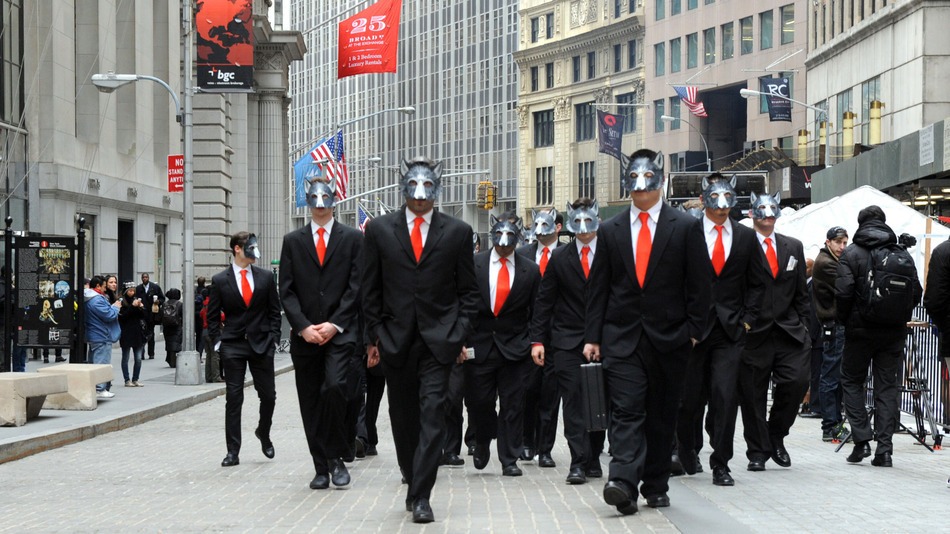
A pack of “wolves” invade Wall Street as a promotion for the Blu-Ray release of The Wolf of Wall Street.
IMAGE: DIANE BONDAREFF/INVISION FOR PARAMOUNT PICTURES/ASSOCIATED PRESS
A new report suggests that instilling ethics in Wall Street may be as hard as teaching an old dog new tricks.
Years after a worldwide financial crisis battered the industry, bankers continue to engage in much of the same unethical conduct that helped trigger the meltdown, a survey of financial professionals in the United States and the United Kingdom finds.
In the wake of the collapse, Congress passed the Dodd Frank Act in 2010, a bundle of sweeping financial reforms billed as the biggest overhaul of banking rules since the Great Depression. Firms committed to rein in the industry’s Wild West culture, and regulatory agencies vowed to double down on fraud.
But the latest survey, conducted by Notre Dame and Labaton Sucharow, a New York law firm known for protecting financial whistleblowers, indicates that the financial sector may be increasingly reverting to old habits.
Nearly a quarter of the 1,200 financial workers surveyed said they suspected their colleagues had engaged in unethical or illegal activity Nearly a quarter of the 1,200 financial workers surveyed said they suspected their colleagues had engaged in unethical or illegal activity in order to get an edge in the market. That’s nearly double the number that a similar survey reported in 2012.
Additionally, nearly 50% said their rivals had likely cheated to get ahead, and about one in five said that breaking the rules is necessary for success in the hyper-competitive industry. Both figures represent a significant jump from three years ago.
Each of these stats is slightly higher among those with salaries of half a million dollars or more, implying that wrongdoing may proliferate as Wall Street’s workers gain more pay and experience.
What’s more is that workers who speak out about ethical breaches may face consequences, according to the survey. One fifth of those polled said that they would fear retaliation from their firms if they reported issues to regulators.
“When corporate whistleblowers are prohibited, discouraged or retaliated against for reporting crime to cops, we should all be scared—very scared,” Jordan Thomas, a Labatan partner who co-authored the report said in a statement.
The troubling backslide in attitudes towards ethics shows that more reform is still needed to achieve a real change in industry culture, according to co-author Ann Tenbrunsel, business ethics professor at the Mendoza College of Business.
“Despite significant energy and efforts, it appears we need to continue to think about how to improve the culture of ethics in the financial services industry,” Tenbrunsel said.
Message to UK CEOs from the Institute of Mediocre Management. Come on get with the program (its a U.S. report so its spelled correctly) and see if we can’t deliver ourselves higher rises than this in 2015. How? Re-organise, Re-Size and Accounts massaging, you know the drill. Winner gets to sit next to Rt Hon DC at our next awards dinner!

Wrong! Wrong Wrong!
A new book about the gut that has sold more than a million copies in Germany would make ideal loo reading, had it not included a chapter about the problem of sitting down to defecate.
We did not evolve to linger on porcelain thrones, you see, and in those countries where squatting remains normal, colons and their owners are demonstrably happier.
“There is a muscle that encircles the gut like a lasso when we are sitting… creating a kink in the tube,” Giulia Enders explains in Gut: The Inside Story of Our Body’s Most Underrated Organ.
She calls the mechanism “an extra insurance policy and cites studies showing that squatters, with their unkinked guts, are less susceptible to haemorrhoids and constipation.
Enders first got noticed – and a book deal – after a self-assured turn at a science slam in Berlin three years ago. Her 10-minute lecture went viral on YouTube, and now, weeks after completing her final exams as a doctoral student, she is a publishing sensation. Her book, called Darm Mit Charme (“Charming Bowels”) in Germany, has sold more than 1.3 million copies since it came out last year. Rights have been sold to dozens of countries including the US, and her UK publisher ordered thousands more copies last week, days after the book went on sale.
The German’s way into the gut is a lightness that some reviewers have found too childish or lacking in scientific rigour to be taken seriously. But there is something compelling and refreshing about her curiosity and popular approach. “When I read the research, I think: Why don’t people know about this – why am I reading about it in some paper or specialist magazine? It’s ridiculous because everyone has to deal with it on a daily basis. I want to transport that feeling I had to more people.”
‘Gut: The Inside Story Of Our Body’s Most Underrated Organ’ by Giulia Enders (Scribe, £14.99) is out now
And the point is?
If you want to be the writer of a best selling book
Sh*t sells
There’s hope for all of us then! Happy writing!

David Cameron is going to tell his National Security Council this as he announces plans to crack down on workers (colleagues, staff etc).
According to a briefing, Cameron is expected to say:
For too long, we have been a passively tolerant society, saying to our citizens: as long as you obey the law, we will leave you alone. It’s often meant we have stood neutral between different values. And that’s helped foster a narrative of extremism and grievance. This Government will conclusively turn the page on this failed approach.
He will say Thought Leaders believe in “certain values”, adding: “To belong to a Company is to believe in these things. And it means confronting head-on the poisonous socialist extremist ideology. Whether they are violent in their means or not, we must make it impossible for the Unions to succeed.”
It’s expected Cameron will introduce a counter-workers bill in his Queen’s Speech later in May. Planned measures include introducing new orders to ban staff councils and restrict people who seek to radicalise apprentices and interns via inductions and ‘showing them around’.
The new package is expected to include:
The introduction of banning orders for organisations who stand up for workers rights in public places, but whose activities fall short of proscription.
New Disruption Orders to restrict people who seek to restrict Thought Leaders’ pay and conditions packages;
Powers to close staff restaurants and sports clubs where left leaning staff may seek to influence others;
Strengthening the powers of the Charity Commission to root out charities who misappropriate funds towards the poor, sick and other malingerers;
Further immigration restrictions on extremists i.e people who can’t buy a house for at least a £1million;
A strengthened role for Ofcom to take action against channels which broadcast extremist content such as HIGNFY.

From an article by Neil Irwin (New York Times)
Imagine an elite professional services firm with a high-performing, workaholic culture. Everyone is expected to turn on a dime to serve a client, travel at a moment’s notice, and be available pretty much every evening and weekend. It can make for a grueling work life, but at the highest levels of accounting, law, investment banking and consulting firms, it is just the way things are.
Except for one dirty little secret: Some of the people ostensibly turning in those 80- or 90-hour workweeks, particularly men, may just be faking it.
Many of them were, at least, at one elite consulting firm studied by Erin Reid, a professor at Boston University’s Questrom School of Business. It’s impossible to know if what she learned at that unidentified consulting firm applies across the world of work more broadly. But her research, published in the academic journal Organization Science, offers a way to understand how the professional world differs between men and women, and some of the ways a hard-charging culture that emphasizes long hours above all can make some companies worse off.

(c) Peter Arkle
Ms. Reid interviewed more than 100 people in the American offices of a global consulting firm and had access to performance reviews and internal human resources documents. At the firm there was a strong culture around long hours and responding to clients promptly.
“When the client needs me to be somewhere, I just have to be there,” said one of the consultants Ms. Reid interviewed. “And if you can’t be there, it’s probably because you’ve got another client meeting at the same time. You know it’s tough to say I can’t be there because my son had a Cub Scout meeting.”
Some people fully embraced this culture and put in the long hours, and they tended to be top performers. Others openly pushed back against it, insisting upon lighter and more flexible work hours, or less travel; they were punished in their performance reviews.
The third group is most interesting. Some 31 percent of the men and 11 percent of the women whose records Ms. Reid examined managed to achieve the benefits of a more moderate work schedule without explicitly asking for it.
They made an effort to line up clients who were local, reducing the need for travel. When they skipped work to spend time with their children or spouse, they didn’t call attention to it. One team on which several members had small children agreed among themselves to cover for one another so that everyone could have more flexible hours.
A male junior manager described working to have repeat consulting engagements with a company near enough to his home that he could take care of it with day trips. “I try to head out by 5, get home at 5:30, have dinner, play with my daughter,” he said, adding that he generally kept weekend work down to two hours of catching up on email.
Despite the limited hours, he said: “I know what clients are expecting. So I deliver above that.” He received a high performance review and a promotion.
What is fascinating about the firm Ms. Reid studied is that these people, who in her terminology were “passing” as workaholics, received performance reviews that were as strong as their hyper-ambitious colleagues. For people who were good at faking it, there was no real damage done by their lighter workloads.
It calls to mind the episode of “Seinfeld” in which George Costanza leaves his car in the parking lot at Yankee Stadium, where he works, and gets a promotion because his boss sees the car and thinks he is getting to work earlier and staying later than anyone else. (The strategy goes awry for him, and is not recommended for any aspiring partners in a consulting firm.)
A second finding is that women, particularly those with young children, were much more likely to request greater flexibility through more formal means, such as returning from maternity leave with an explicitly reduced schedule. Men who requested a paternity leave seemed to be punished come review time, and so may have felt more need to take time to spend with their families through those unofficial methods.
The result of this is easy to see: Those specifically requesting a lighter workload, who were disproportionately women, suffered in their performance reviews; those who took a lighter workload more discreetly didn’t suffer. The maxim of “ask forgiveness, not permission” seemed to apply.
It would be dangerous to extrapolate too much from a study at one firm, but Ms. Reid said in an interview that since publishing a summary of her research in Harvard Business Review she has heard from people in a variety of industries describing the same dynamic.
High-octane professional service firms are that way for a reason, and no one would doubt that insane hours and lots of travel can be necessary if you’re a lawyer on the verge of a big trial, an accountant right before tax day or an investment banker advising on a huge merger.
But the fact that the consultants who quietly lightened their workload did just as well in their performance reviews as those who were truly working 80 or more hours a week suggests that in normal times, heavy workloads may be more about signaling devotion to a firm than really being more productive. The person working 80 hours isn’t necessarily serving clients any better than the person working 50.
In other words, maybe the real problem isn’t men faking greater devotion to their jobs. Maybe it’s that too many companies reward the wrong things, favoring the illusion of extraordinary effort over actual productivity.

There’s lots of good advice available on what to do at the Gym. This is what you probably shouldn’t do….
1] Join a Gym
No seriously, a Gym has absolutely no health benefits whatsoever, you cannot get fitter or lose weight there. It’s the exercise when you are at the Gym that does this. So if you not going to go there regularly and work out basis, save your money
2] Ignore Your Health
If you are going to join a Gym for the social kudos of being able to say ‘I have Gym membership’ and then only use their spa facilities and café you have no need to seek medical advice so long as you keep the chocolate cake and frappe consumption to reasonable levels.
If however you are intending going from sloth to super fit in weeks you may just want to run it by a medical expert. Douglas Adams, the brilliant author of the Hitch Hiker’s Guide to the Galaxy sadly passed away exercising in a Gym at a mere 49 so be warned!
3] Forget Hygiene
To get fit you are going to have to work out and raise a sweat and you will give off body odour. Unless you are the Tooth Fairy or Spiderman it will be a whiffy sort of smell. So wear deodorant and it probably best to hide those armpits.The clue is when you realise no one ever uses the machines next to you.
4] Sip Water
If you are thirsty, have a drink. There is absolutely no need to take a sip every thirty seconds as it’s not necessary. All you need to do is replace the liquid that you have sweated out so there’s no need to carry round that 2 litre bottle of triple-purified, Elderflower scented organic Alp water taking ostentatious sips between each lift of the 0.5 Kg dumbbell.
5] Forget a ‘wipe off’ towel
While we are on the subject of sweating, such a nice subject, please remember that this precious liquid is yours and yours only and should never be shared with anyone you don’t know intimately and then only in private.
Therefore should any drop of sweat from your perspiring extremities leave your body then use a towel to wipe it off the machine surfaces after you have finished. You could bring a can of Mr Cleaney with you but this is considered over the top.
6] Use the equipment incorrectly
Check the equipment out and ask for help if it’s not clear what to do. Or if you are very shy watch someone else use it (don’t stare with your mouth open as this is also considered bad form) and then copy what they did.
Note; if you try something and it is a] too heavy b] too fast c] won’t move, then stop and adjust. If that doesn’t work move discretely to the next station. Next time you are by that machine go back to the beginning of the first paragraph and follow the advice in the first sentence.
7] Give up easily
Working out is good for getting fitter and losing weight. But you need to put some effort in. The clue here is feeling more tired physically leaving the gym than when you came in. This means you will have exercised your muscles and burnt off some fat and calories. The more effort; the better the results.
For weight loss, 2lbs a week is considered by experts to be a reasonable rate of change. By my calculation an average 12st man will weigh nothing in around a year and a half so there is no need to sign up your Gym membership for more than a year.
How about Yoga? Researchers in one study found that those who started out overweight but did at least one session of yoga a week lost about 5lb over ten years. Which means you need around 330 years to achieve weightlessness using Yoga.
8] Buy the latest, expensive, branded gym wear
Are you here for a fashion show or looking for a mate? Research has also shown that £100 tops or running vests do not make you run faster or lose weight quicker.
They simply highlight you as a newbie or someone not confident about their appearance. Get over it. We’re all here because we foolishly think we can eventually become supermodels or at least head-turners. So save your cash and wear something loose and comfortable that will survive multiple washes. The latter helps with point 3] as well.
9] Use your phone
It is never ever acceptable to use your phone in the gym. That means no voice calls, texting or emails. Yes, you can listen to music from it.
If your life is so thin that you feel you have to be multitasking when you should be focused on one thing, getting fitter, then mentally you are unlikely to achieve your physical goals. You’ll never hit the Zone, find the body and mind working in parallel or discover what a good workout can really feel like. Plus it’s irritating and distracting to other users. So leave the phone in the locker.
10] Show your naked body to everyone
Obviously not in the Gym itself as this is likely to cause consternation and could also cause serious harm with people firing backwards off running machines and dropping weights onto their toes.
This refers to the changing room. If you are removing clothes to change or go to the shower do it discretely. No need to be the virgin on the beach and wrap towels around you, just get changed. But don’t be you 5 year-old self and wander around the changing room with your bits on display until you naturally dry off. No-one wants to see this. If you are a natural extrovert and want some attention go to the other changing room where the men/women there will give you all the attention that you require.
(Written on mobile phone, whilst in Gym cafe as I forgot my designer towel and was also feeling fat, hot and sweaty ……and yup I was naked…)

Salary!! You want a Salary??
Job candidates must be prepared for anything during an interview. That’s why Glassdoor has combed through thousands of interview questions shared by UK job candidates over the past year to compile its list of Top 10 Tough Interview Questions asked in the UK
(1) “Can you calculate how many tennis balls are used during the course of Wimbledon?” Asked at Accenture.
(2) “Estimate the total number of cars in the UK.” Asked at Barclays Capital.
(3) “How many calories are in a grocery store?” Asked at Google.
(4) “How would you sell a fridge to an eskimo? Asked at Harrods.
(5) “What would you take to a lonely island with you and why?” Asked at Urban Outfitters.
(6) “Is Batman a super hero?” Asked at AlphaSights
(7) “You have 17 red and 17 blue balls, and you remove 2 at a time. If the two are the same colour, add in one extra blue ball. If they are different colours, add in an extra red ball. What colour is the final ball removed?” Asked at Geonomics.
(8) “What cartoon character would you be and why Asked at ASDA.
(9) “What is the wildest thing you have done?” Asked at Metro Bank.
(10) “What was your opinion of the film Blair Witch Project?” Asked at Jefferies & Company.
I can only suggest that you try to answer the smug gits as a smack on the mouth will often offend………
These were the top 10 things everyday emergencies Britons found stressful:
1. Not being able to sleep (46 per cent)
2. Losing your keys (37 per cent)
3. Being stuck in traffic when already late (35 per cent)
4. Losing an important paper or document (33 per cent)
5. Nowhere to park (32 per cent)
6. Printer not working when you need to print something (31 per cent)
7. Running out of battery on your phone whilst out (31 per cent)
8. Discovering you are out of toilet roll whilst on the loo (30 per cent)
9. Dealing with machine operated customer service (26 per cent)
10. Forgetting your bank card when paying for an item (25 per cent)
Anything else that’s been missed? Let us know…

Direct Line polled 2,005 UK adults to investigate why some common things can be so stressful, in research done in conjunction with Goldsmiths University
 How To Get To The Top